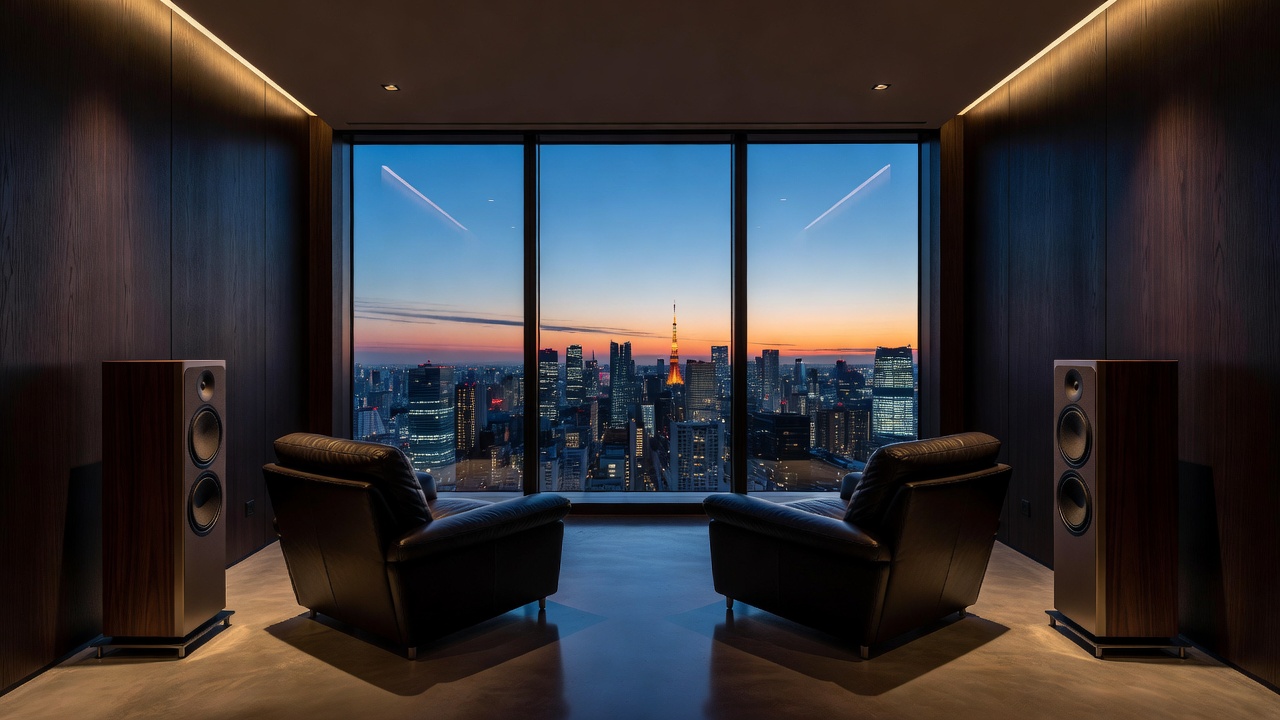
Minato Residence.
Taming a modern glass-and-concrete apartment to create an intimate sanctuary for a vast vinyl collection.
Minato, Tokyo
Glass Reflections, Bass Nulls
Calibration, Custom Panels
The Acoustic Hostility of Modern Luxury
Our client possessed a superlative analog system anchored by reference-grade floorstanding speakers and a heavy-mass turntable. However, the system was housed in a stunning, but acoustically hostile, high-rise apartment. Floor-to-ceiling windows on two sides, hard concrete floors, and parallel walls created a chaotic reverberant field. The sound was characterized as "bright," "fatiguing," and lacking low-end definition.
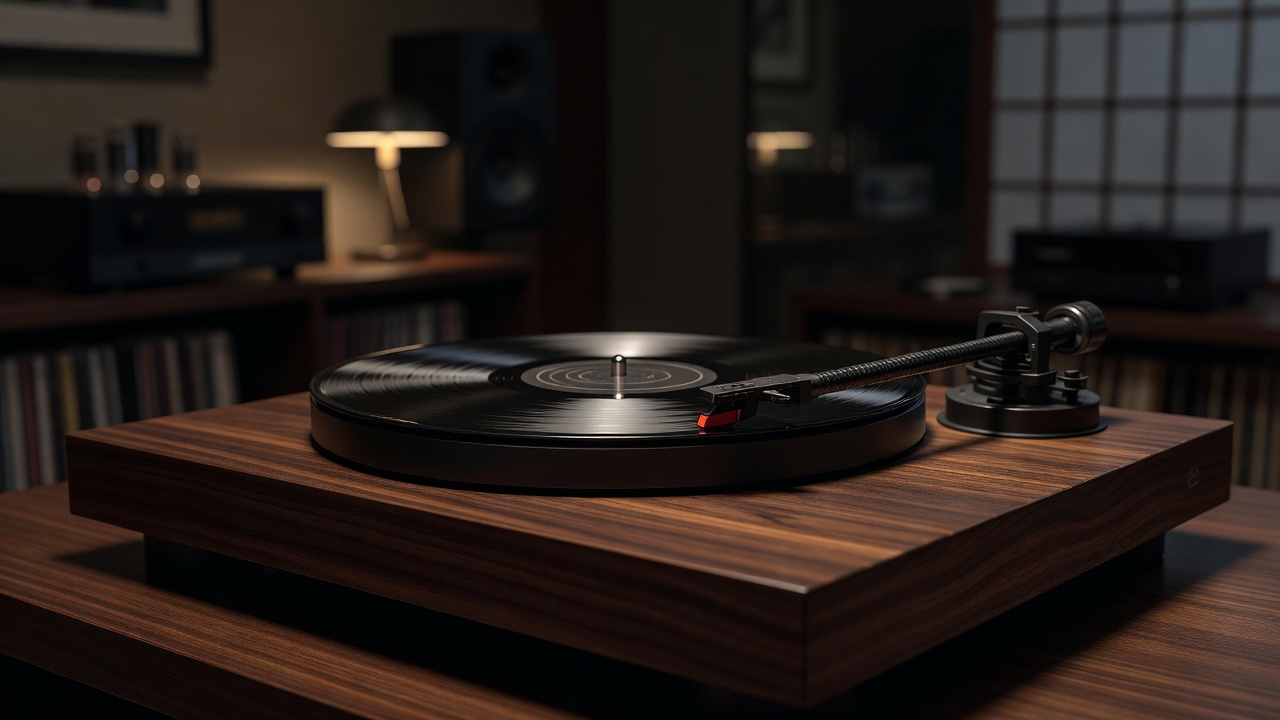
Diagnostic Measurement
Initial impulse response measurements revealed an RT60 (reverberation time) of nearly 1.2 seconds in the midrange—unacceptable for critical listening. Severe comb filtering was evident due to first reflections off the glass windows, destroying the stereo imaging. Furthermore, a massive room mode at 45Hz was causing a muddy, booming bass response.
Bespoke Intervention
Because aesthetics were paramount, standard acoustic foam was out of the question. Our intervention included:
Invisible Bass Trapping
We designed custom, high-mass cabinetry to house the client's vinyl collection. Hidden within the dead space of these cabinets were tuned Helmholtz resonators designed specifically to absorb the 45Hz mode.
Motorized Acoustic Drapes
For the expansive glass, we installed heavy, multi-layered acoustic draping on motorized tracks. When listening, they close to absorb high-frequency reflections; when entertaining, they open to reveal the skyline.
Kumiko Diffusion
On the rear wall, we installed a massive, custom-crafted Japanese Kumiko wood screen. While visually striking, it mathematically functions as a quadratic residue diffuser, scattering sound to maintain room energy without echoing.
The Result
Post-installation measurements showed the RT60 dropped to a controlled 0.4 seconds. The frequency response flattened significantly. Subjectively, the system "disappeared." The harshness was replaced by a smooth, holographic soundstage, allowing the client to listen for hours without fatigue, suspended above the city.